

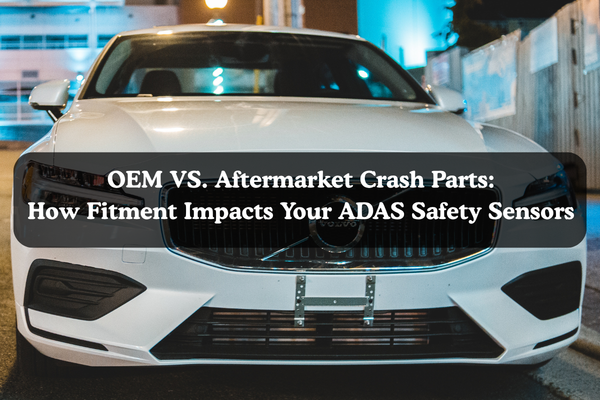
OEM vs Aftermarket Parts: Impact on ADAS Safety
OEM collision repair Mesquite, OEM vs aftermarket body parts, ADAS sensor calibration Mesquite, certified auto body shop Mesquite, safe collision repair
OEM vs. Aftermarket Crash Parts: How Fitment Impacts Your ADAS Safety Sensors
If your newer vehicle has been in a collision, the decision between OEM and aftermarket body parts is no longer just about looks or cost. The parts that hold your Advanced Driver Assistance Systems (ADAS) can directly affect how well your safety sensors protect you and your family on the road.
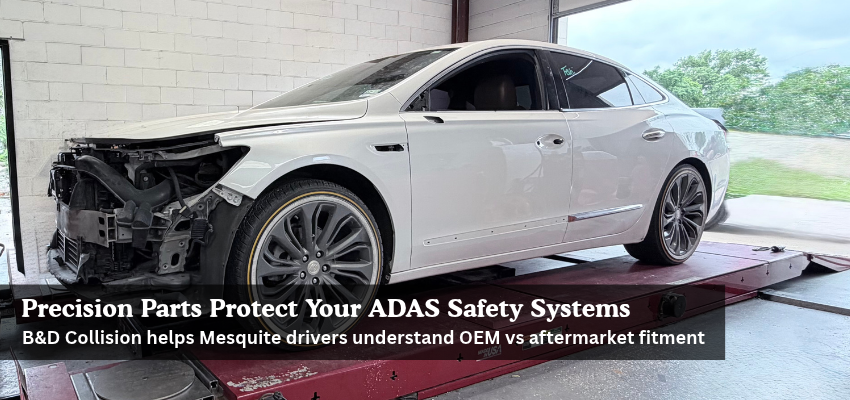
What changed: Why are bumpers, grilles, mirrors, and windshields now safety equipment?
For decades, exterior body panels were mostly cosmetic. A bumper cover or grille was basically a decorative shell. On today’s vehicles, those same parts are precision housings and lenses for ADAS technology like automatic emergency braking, lane keeping assistance, blind spot monitoring, and adaptive cruise control. Federal safety programs such as NHTSA’s New Car Assessment Program now evaluate many of these systems as part of a vehicle’s crash avoidance rating, which means manufacturers engineer them with incredible precision from the factory.
On a typical late model vehicle, you may have:
Radar units hidden behind the front bumper cover or grille that handle automatic emergency braking and adaptive cruise control.
Cameras mounted behind the windshield glass watching lane lines, traffic signs, and pedestrians.
Blind spot radar units tucked behind rear bumper covers or in the corners of the vehicle.
Side mirror housings that contain cameras and warning lights for lane change assistance.
These components are no longer just “trim.” They are carefully engineered to position and protect the electronics that help prevent crashes in the first place. When B&D Collision performs safe collision repair on a vehicle with ADAS, we treat those exterior pieces as part of your safety system, not just bodywork.
What is the difference between OEM and aftermarket crash parts for ADAS-equipped vehicles?
How are OEM collision parts designed and tested?
Original Equipment Manufacturer (OEM) parts are engineered by the same company that built your vehicle. That means the bumper cover, grille, windshield, or mirror housing is designed alongside the radar, camera, and sensor packages.
The manufacturer controls:
Exact plastic and resin composition for predictable strength and flexibility.
Panel thickness down to fractions of a millimeter so radar waves and camera views are not distorted.
Mounting hole location and clip alignment so the sensor brackets sit exactly where they were designed to sit.
Paint formulas, including metallic flake size and distribution, so the finish does not interfere with radar transparency.
OEM parts are tested with the entire vehicle as a system. When NHTSA or Euro NCAP evaluates automatic emergency braking or lane keeping, they are testing the OEM configuration: the exact parts, materials, and sensor locations that came from the factory. At B&D Collision, that is the standard we use when we talk about OEM collision repair at our shop in Mesquite.
How do aftermarket body parts differ from OEM parts in critical details?
Aftermarket crash parts are usually reverse engineered. A manufacturer measures an OEM bumper cover or grille and creates a copy. Many aftermarket suppliers work hard to produce quality components, and not every aftermarket part is unsafe. However, even small differences can matter a lot for ADAS performance.
Common variations include:
Different resin mixtures or plastic density that change how radar waves pass through the panel.
Slightly thicker or thinner material that shifts the sensor’s “view” forward or backward compared with OEM design.
Mounting tabs or clip locations that are off by a millimeter or two, forcing the technician to flex or adjust the part to make it fit.
Paint processes that use different metallic flake or pigment, which can reflect or scatter radar energy differently than OEM finishes.
On an older vehicle with no ADAS, those differences might only affect appearance or panel gaps. On a 2024 SUV with front radar and 360-degree cameras, the same differences can change when and how your safety systems react. That is why OEM vs aftermarket body parts is a serious safety conversation, not just a budget decision.
What is the “tolerance stack” problem and why does a millimeter matter for ADAS?
Every manufactured part has a small allowable variation called tolerance. When you replace one part with a slightly different component, the difference may be tiny. The challenge comes when several small differences pile up. This is known as tolerance stack, and it can have a big impact on ADAS sensor aim and timing.
How can a 1 millimeter or 2 degree change affect radar and cameras?
Imagine an aftermarket bumper cover that is just 1 millimeter thicker than the OEM design in front of the radar unit. The mounting bracket holes are also shifted half a millimeter up and to the side. To make it fit, the bracket is tightened slightly off center, changing the angle of the radar by 1 or 2 degrees. In the shop, this might not be visible to the naked eye. On a Texas highway at 70 miles per hour, that small angle change can move the radar beam several feet off target by the time it reaches a vehicle 100 feet ahead of you.
The result can be:
A blind spot where the radar no longer “sees” a vehicle in front of you in time to trigger automatic emergency braking.
False emergency braking events when the sensor locks onto an object in another lane or on the shoulder.
Lane keeping assistance that drifts or tugs unexpectedly because the camera’s view through the windshield is slightly skewed.
📌 Key Takeaway: When ADAS sensors are involved, “close enough” is not safe enough. Precision fitment is part of safe collision repair, not an extra.
Why does bumper and grille material thickness affect radar sensors?
How do radar units “see” through emblems and grilles?
Front radar sensors use radio waves that travel through certain plastics with very little loss or distortion. Automakers select specific radar-transparent materials for bumper covers, grilles, and especially the emblem area in front of the radar. The material’s thickness, density, and paint layers are tuned so the radar beam passes through like light through a clean window. This is part of why OEM parts are so tightly controlled for ADAS zones.
What happens when aftermarket plastics or paint interfere with radar transparency?
A non-certified aftermarket grille or emblem might use a different plastic formula or thicker paint build. Even if it looks identical from the outside, the radar waves can be:
Blocked, which shortens the radar’s range and delays warnings or automatic braking.
Reflected back into the sensor, creating “ghost” readings that cause false alerts or erratic cruise control behavior.
Scattered, which widens the beam and makes it harder for the system to distinguish real vehicles or pedestrians.
Research and safety organizations have raised concerns that some aftermarket parts can interfere with ADAS performance in exactly these ways. When B&D Collision evaluates a repair plan, we look at whether the part in front of a radar or camera is specifically approved for that purpose. If it is not, we explain to our customers why an OEM equivalent component may be the safer choice for their family.
Why does an I-CAR Gold Class certified process matter for ADAS sensor calibration?
How does B&D Collision in Mesquite follow OEM repair procedures for ADAS-equipped vehicles?
B&D Collision is proud to be an I-CAR Gold Class certified auto body shop Mesquite drivers can count on. This elite status means our technicians receive ongoing training in the latest OEM repair procedures, including ADAS sensor handling and calibration. We do not guess. We follow the same instructions the automaker wrote for its dealer network, step by step, for your specific year, make, and model.
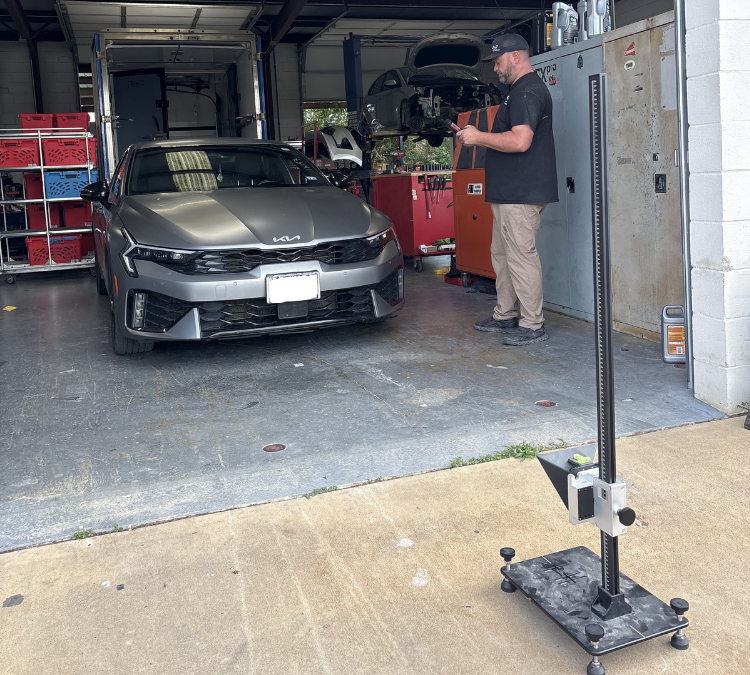
For ADAS-equipped vehicles, that process typically includes:
Pre-repair computerized scanning to see which sensors or modules have stored trouble codes from the collision.
Careful documentation of which components are damaged and which OEM vs aftermarket body parts are acceptable in ADAS zones according to the manufacturer.
Exacting structural and body measurements so sensor mounting points return to factory dimensions.
Post-repair scanning and ADAS sensor calibration Mesquite drivers can rely on, using specialized equipment and targets to verify every radar and camera is aimed correctly.
💡 Pro Tip: Any time a front bumper, grille, windshield, or side mirror is replaced on a modern vehicle, ask if a calibration is required. If the answer is uncertain, that is a red flag.
How does a faith-based, family-owned shop advocate for your safety?
As a faith-based, family-owned business serving Mesquite for more than 35 years, B&D Collision approaches every vehicle as if our own loved ones will ride in it. That means we take the time to explain your options, including when OEM parts are strongly recommended in ADAS critical areas. We work with insurance carriers every day, but our first responsibility is to your safety and to the engineering standards your vehicle was built to meet.
Our commitment to safe collision repair includes:
Transparent repair plans that identify where OEM parts are critical for sensor performance.
Clear communication if an aftermarket part might compromise ADAS function based on OEM procedures or industry guidance.
A focus on occupant safety and long-term reliability, not just getting the vehicle out the door quickly.
How can Mesquite drivers make confident choices about OEM vs aftermarket parts for ADAS repairs?
If your vehicle has been in a collision and you know it has features like automatic emergency braking, lane keeping, blind spot monitoring, or adaptive cruise control, it is wise to ask detailed questions before any parts are ordered. Here are a few to consider:
Which parts on my repair estimate are located in front of, or attached to, ADAS sensors or cameras?
Are OEM parts specified for those locations, and if not, why not?
What calibration procedures will be performed after the repair, and will there be documentation showing the results?
Is the shop I-CAR Gold Class certified and experienced with ADAS sensor calibration for today’s vehicles?
A trustworthy, certified auto body shop will welcome these questions and be ready to walk you through the answers in plain language. At B&D Collision, those conversations are part of how we advocate for you and your family’s safety.
Ready to protect your ADAS safety systems with precision collision repair?
Choosing OEM vs aftermarket body parts is no longer a simple cosmetic decision. On ADAS-equipped vehicles, the fitment, material, and mounting of bumpers, grilles, mirrors, and windshields can change how your safety sensors perform in a split second when it matters most. A millimeter of misalignment or the wrong plastic in front of a radar unit can mean the difference between a smooth stop and a serious crash.
If you are facing a collision repair decision in Mesquite or anywhere in North Texas, we invite you to see what your neighbors say about us. Take a moment to check out our local reviews to learn why so many North Texas drivers trust our family-owned shop with their vehicles and their family’s safety.
When you are ready, contact B&D Collision for expert collision repair. Call (972) 289-3291 to schedule a free estimate, or use our website calendar to book an appointment at a time that works for you. Our I-CAR Gold Class team will review your repair plan, explain your OEM and aftermarket part options clearly, and make sure your ADAS sensors are calibrated and verified before we hand the keys back. Your vehicle is more than transportation. It carries the people you love, and it deserves the same care and integrity we would want for our own families.


